2025–2026 Industry Research & Implementation Playbook
How Realtors in the United States Generate Leads
The evidence-based handbook for acquiring, converting, and retaining residential real estate clients—with current channel economics, brokerage analysis, technology, budgets, automation, AI, and a 100-point growth scorecard.
Editorial note
“REALTOR®” means an NAR member; “agent” means a licensed real estate professional more broadly. Compensation is always negotiable. This report is educational and is not legal, tax, fair-housing, or brokerage-compliance advice.
Table of Contents
- 1. Current state of the U.S. residential real estate market
- 2. How Realtors actually generate leads
- 3. Brokerage choice as a lead-generation decision
- 4. MLS, IDX, VOW, and listing websites
- 5. The agent website decision
- 6. Google Business Profile
- 7. Facebook and Instagram lead generation
- 8. LinkedIn
- 9. Google Ads
- 10. SEO, Maps, and AI search
- 11. YouTube
- 12. Realtor technology stack
- 13. Marketing budget benchmarks
- 14. Economics of lead generation
- 15. AI for Realtors
- 16. Roadmap for aspiring Realtors
- 17. The 100-point Realtor growth scorecard
- 18. Future of the industry
- Final chapter: when an integrated growth partner makes sense
- Frequently asked questions
- Source notes and research bibliography
Executive summary
The lead-generation business is easy to misunderstand because vendors sell leads, while agents earn money from closings. The unit that matters is not cost per lead (CPL). It is contribution profit per closed transaction after referral fees, brokerage split, marketing, labor, and servicing costs.
The evidence supports seven conclusions:
- Relationships remain the economic center of the industry. In NAR’s 2026 Member Profile, the typical member attributed 28% of 2025 business to repeat clients and 22% to past-client referrals. By contrast, 69% received no business from paid third-party lead generation. In NAR’s buyer research, 40% of buyers found their agent through a friend, neighbor, or relative, and 17% reused an agent.
- Cheap leads are frequently expensive customers. Meta forms can produce inexpensive names, but low intent, bad contact data, and long nurture create high labor-adjusted CAC. Search, referrals, and repeat clients generally cost more per visible inquiry—or appear to cost nothing—but convert better.
- Speed matters most when intent is perishable. Portal, PPC, sign-call, and social-form leads should receive an immediate automated acknowledgment and a human attempt within five minutes when operationally possible. Sphere, SEO, video, and nurture leads reward relevance and continuity more than frantic dialing.
- The median agent is not running a large ad operation. NAR reported median 2025 spending of $950 on marketing services, $620 on listing marketing, $740 on technology, and zero on paid lead generation and social advertising. These medians include many zero-spenders; they describe the market, not an optimal growth budget.
- The post-settlement skill is explaining and defending value. Since August 17, 2024, covered MLS participants must use written buyer agreements before touring, and compensation cannot be offered in the MLS. Redfin’s Q3 2025 data put the average buyer-agent commission at 2.42%, showing no immediate collapse—but more buyers and sellers now negotiate.
- Owned demand compounds; rented demand resets monthly. Reviews, a permission-based database, branded search, neighborhood content, and referral partnerships can lower CAC over time. Portal and ad inventory stop when payment stops.
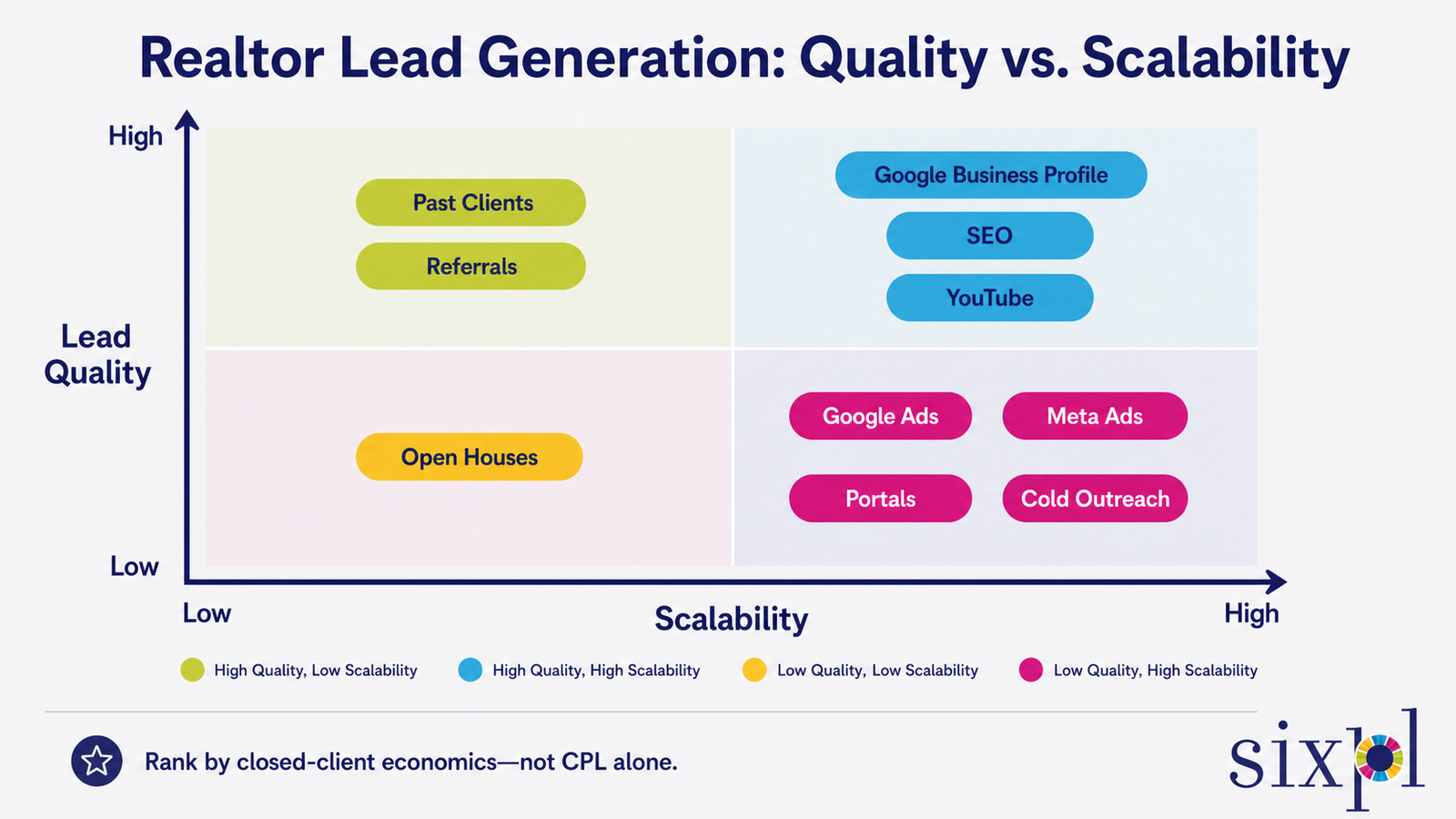
- A diversified system beats channel chasing. A practical solo-agent portfolio is 50–70% relationship and community activity, 15–30% owned discovery (Google Business Profile, website, SEO, video), and no more than 20–30% experimental paid acquisition until attribution proves otherwise.
Decision rule: Scale a channel only after it produces a cohort of closed transactions at an acceptable CAC. Never scale because CPL looks attractive.
1. Current state of the U.S. residential real estate market
An oversupplied profession serving a constrained transaction market
NAR reported 1,438,569 members in spring 2026, down from 1,463,352 a year earlier. At the same time, May 2026 existing-home sales ran at a 4.17 million seasonally adjusted annual rate, with a $429,300 median price and 4.5 months of inventory. New-home sales ran at a 580,000 annual rate in May 2026, with 10.3 months of supply. Those are not directly additive annual totals, but they show the core competitive fact: there are many practitioners relative to available transactions.
The 2026 NAR Member Profile, based on 5,116 responses and weighted to state membership, provides the best current operating snapshot:
| 2025 measure | Result | Interpretation |
|---|---|---|
| Median individual sides | 9 | A side is one represented party, not necessarily one whole transaction |
| Zero residential sides | 6% | Active membership does not imply production |
| 1–5 residential sides | 30% | 36% closed five or fewer when zero is included |
| Median sides, ≤2 years’ experience | 2 | Early-career economics are severe |
| Median sales volume | $2.7M | Residential specialists: $2.4M |
| Median gross real-estate income | $59,200 | Before business expenses and taxes |
| Median net income | $37,000 | NAR reports this as after taxes and expenses |
| Median gross income, sales agents | $41,700 | Broker licensees earned materially more |
| Gross income below $10,000 | 19% | 26% among sales agents |
| Median total business expenses | $9,530 | Up from $8,010 in 2024 |
| Median income, ≤2 years | $8,000 | A more defensible figure than social-media anecdotes |
| Median income, 16+ years | $88,500 | Database and experience compound |
There is no credible national “failure rate” registry. Claims such as “87% fail in five years” usually recycle an unsourced statistic and should not be published as fact. Better evidence is production and income distribution: 31% of agents with two years or less had zero residential sides, another 44% had one to five, and their median gross income was $8,000. Attrition is real; the precise failure rate is not established.
Market constraints
The latest official snapshots show a market constrained by affordability, rate lock-in, and uneven inventory. NAR members named affordability as the leading client obstacle. The 2025 buyer profile found the first-time-buyer share fell to a record-low 21%, while the median first-time buyer reached age 40. Yet agency remained prevalent: 88% of buyers and 91% of sellers used an agent or broker; FSBO fell to 5%.
This combination changes lead strategy. There may be fewer transaction-ready consumers, longer decision cycles, more failed preapprovals, and greater pressure to demonstrate financial and negotiating value. Agents should therefore measure qualified opportunity rate, not just inquiry count.
Commission economics after the NAR settlement
The NAR settlement practice changes effective August 17, 2024 require written buyer agreements before touring for agents using covered MLSs, remove offers of broker compensation from the MLS, and require compensation to be objectively ascertainable rather than open-ended. Offers may still occur off-MLS, subject to law and agreement.
The short-run data do not support claims that buyer-agent compensation disappeared. Redfin reported an average 2.42% buyer-agent commission in Q3 2025; the rate varied by price tier, and its dataset is not the entire market. The durable changes are disclosure, negotiation, documentation, and a clearer burden on buyer agents to articulate value early.
A realistic commission waterfall
Assume a $429,300 sale, a 2.42% side commission, an 80/20 brokerage split, and $650 in transaction/E&O fees:
| Item | Calculation | Amount |
|---|---|---|
| Gross commission income (GCI) | $429,300 × 2.42% | $10,389 |
| Brokerage share | $10,389 × 20% | −$2,078 |
| Transaction-related fees | Assumption | −$650 |
| Agent contribution before lead cost, service cost, and tax | $7,661 |
If a portal or referral partner receives 35% of GCI, another $3,636 leaves the waterfall. The agent then has $4,025 before marketing, showing assistance, mileage, client service, and tax. This is why a “free” success-fee lead can have a higher CAC than a $100 search lead.
AI disruption and consumer behavior
AI is lowering the cost of generic content, transcription, initial response, and database segmentation. It is not lowering the cost of local trust. As undifferentiated market updates multiply, original local data, first-hand video, reviews, negotiation evidence, and demonstrated responsiveness become more valuable. AI search also reduces predictable website clicks: content must be useful enough to be cited, branded enough to be sought directly, and connected to a conversion path that does not depend on ten blue links.
2. How Realtors actually generate leads
Evidence hierarchy and benchmark warning
No national, audited database reports CPL, lead-to-close rate, and CAC for every real-estate channel. Definitions vary: a portal “lead” may be a shared inquiry; a Meta lead may be a form fill; an SEO lead may be a call; a referral may already be an appointment. The ranges below are planning ranges synthesized from public benchmarks and operating economics, not guarantees. Local price, inventory, brand, offer, speed, team ISA capacity, attribution window, and whether labor is priced can move results by multiples.
Ranked channel matrix
Scores: 5 is best for quality/scale/ROI; competition is 5 when most intense. CPL excludes the agent’s time unless stated. CAC means marketing or referral expense per closed client.
| Rank | Source | Popularity | Planning CPL | Planning lead→close | Quality | Scale | Competition | Typical cash/month | Modeled CAC | Outlook |
|---|---|---|---|---|---|---|---|---|---|---|
| 1 | Past clients / repeat | Very high | $0–$50 | 20–60% | 5 | 3 | 2 | $50–$500 | $50–$500 | Strong |
| 2 | Sphere / client referrals | Very high | $0–$150 | 10–40% | 5 | 3 | 3 | $100–$1,000 | $100–$1,000 | Strong |
| 3 | Agent-to-agent referrals | High | Usually 20–35% of GCI | 15–40% | 5 | 3 | 3 | Variable | 20–35% GCI | Strong |
| 4 | Google Business Profile / local SEO | Rising | $0–$150* | 5–20% | 4 | 4 | 5 | $0–$2,500 | $300–$2,500 | Strong, competitive |
| 5 | Professional partners / community | High | $0–$250 | 5–25% | 4 | 3 | 3 | $100–$1,500 | $300–$2,000 | Strong |
| 6 | Open houses | High | $20–$200 | 2–10% | 3 | 3 | 3 | $100–$1,000 | $500–$3,000 | Stable |
| 7 | Long-form YouTube | Rising | $30–$300* | 2–10% | 4 | 4 | 4 | $100–$3,000 | $500–$4,000 | Strong |
| 8 | Organic SEO / website | Medium | $50–$400* | 2–10% | 4 | 5 | 5 | $500–$5,000 | $800–$5,000 | Strong but slower |
| 9 | Google Search Ads | Medium | ~$100 benchmark | 1–5% | 4 | 5 | 5 | $1,500–$10,000+ | $2,000–$10,000 | Costly, measurable |
| 10 | Expired / FSBO outreach | Medium | $5–$100 plus labor | 1–5% | 3 | 4 | 5 | $100–$1,500 | $500–$5,000 | Cyclical/compliance-sensitive |
| 11 | Direct mail | Medium | $30–$300 response | 0.2–2% of responses close | 3 | 4 | 4 | $500–$10,000 | $1,500–$10,000 | Works with repetition/data |
| 12 | Portal paid leads | High | Market-priced/shared | 1–4% | 2–4 | 5 | 5 | $500–$20,000+ | $2,000–$12,000 or referral % | Consolidating |
| 13 | Meta lead ads | High | ~$28 cross-industry; RE varies | 0.5–3% | 2 | 5 | 4 | $1,000–$10,000 | $1,000–$8,000 | Automation-heavy |
| 14 | Organic social / personal brand | Very high | $0–$200* | 1–10% | 3 | 4 | 5 | $0–$2,500 | $300–$5,000 | Reach volatile |
| 15 | Niche | $0 organic; paid often high | 1–8% | 4 B2B | 3 | 3 | $0–$3,000 | $500–$8,000 | Best for affluent/B2B | |
| 16 | Cold calling / door knocking | Medium | Low cash, high labor | 0.2–2% | 2 | 3 | 4 | $50–$1,000 | $1,000–$8,000 labor-adjusted | Compliance/headwind |
| 17 | TikTok / short video | Rising | $0–$100* | 0.5–3% | 2 | 4 | 4 | $0–$2,500 | Highly variable | Discovery strong, intent weak |
| 18 | Podcasting | Low | $100–$1,000* | Not stable | 3 | 2 | 3 | $200–$3,000 | Highly variable | Brand tool, not direct-response |
*For owned and organic channels, “CPL” divides production cost by attributable inquiries. It is meaningless until a consistent attribution period is chosen.
Why relationship channels rank first
The ranking follows observed behavior, not nostalgia. NAR’s 2025 generational buyer study found 40% of all buyers found their agent through a friend, neighbor, or relative; 17% reused an agent; only 7% came from inquiring about a specific online property, 6% from a website without a specific reference, and 5% from meeting at an open house. NAR’s 2026 Member Profile similarly found median business shares of 28% repeat and 22% referral.
Channel playbooks
Sphere, past clients, and referrals
Economics: highest expected quality and lowest cash CAC, but not free. Price the CRM, events, gifts within ethics rules, homeowner reports, and agent time. A database with no consent, segmentation, or contact cadence is not an asset.
Operating model: tag each person by relationship, geography, ownership status, likely horizon, and last meaningful conversation. Use a quarterly value touch, monthly useful email, annual home-equity review, closing anniversary, and two genuine one-to-one contacts. Ask for an introduction after value is delivered, not in every mass email.
Weaknesses: slow for newcomers, hard to scale without losing authenticity, and vulnerable to inconsistent follow-up. Best for: every agent. Future: strongest defensible source because trust survives platform changes.
Open houses
Open houses create face-to-face intent and local seller visibility. Budget for signs, refreshments, collateral, ads, and follow-up. Use an explicit sign-in consent statement; do not force misleading “registration” claims. Segment visitors into active buyer, neighbor, seller prospect, represented visitor, and curious visitor. Send the property packet immediately, call high-intent prospects the same day, and offer a relevant next step.
The lead-to-close range is wide because hosting another agent’s vacant listing, a new-construction event, and a packed listing launch are different products. Best for: new agents who have time and need conversations. Future: stable.
Expireds, FSBO, cold calling, and door knocking
These can produce listings because the audience is identifiable, but labor and compliance dominate economics. Scrub against the National Do Not Call Registry and applicable state rules; honor opt-outs; understand TCPA restrictions; follow brokerage rules; and never assume a purchased list is callable. Expired owners receive intense competition and may be frustrated. FSBO sellers may value a buyer, a pricing analysis, or a limited service before they value a listing pitch.
Use a diagnosis-led script: what happened, what the owner wants next, what evidence changed, and whether help is welcome. Track contacts per hour, conversations, appointments, signed agreements, and listings—not dials. Avoid when: the business model requires legal ambiguity or automation without consent.
Direct mail and email
Mail works best with a defensible list and repeated local proof: absentee owners, long tenure, probate where lawfully sourced, a farm, or a relevant property event. One drop rarely establishes a benchmark. Use a control creative, unique URL/QR/phone, 6–12 touches, and holdout addresses where scale permits. Email is excellent for nurture but weak when scraped. Authenticate the sending domain, secure permission, provide unsubscribe, and optimize for replies and appointments rather than open rates.
Instagram, TikTok, personal branding, and podcasting
Short-form social is a discovery and familiarity layer, not a complete acquisition system. Instagram is useful for local proof, listing media, Stories, direct messages, and collaboration with community accounts. TikTok can distribute candid neighborhood explanations far beyond an existing audience, but reach is volatile and geographic intent is weak. In both, the operating unit is a series, not an isolated post: “one block in 60 seconds,” weekly contract myth, monthly affordability calculation, or a documented renovation/build process. Include the place name on screen and in speech, substantiate statistics, caption the video, and route interest to an owned page or CRM.
Personal branding works when repeated evidence makes the agent mentally available for a specific need. It fails when “luxury,” “local expert,” or lifestyle imagery substitutes for transaction competence. Measure branded searches, direct traffic, profile-assisted consultations, and referrals—not followers alone.
Podcasting is usually a relationship and content-production tool rather than a direct lead source. A local-business, builder, planner, lender, or homeowner interview can deepen partnerships and yield searchable clips; audio distribution alone rarely justifies production. A lean show may cost $200–$1,000 monthly in editing and tools; a produced show can exceed $3,000. Best for: articulate specialists with access to useful guests and a repurposing system. Avoid when: the agent has not yet maintained a simpler weekly video or email cadence.
Partnerships: lenders, builders, attorneys, CPAs, insurers, and local businesses
Partner channels transfer trust. They also create RESPA, licensing, disclosure, privacy, and conflict risks. Never pay for settlement-service referrals in a way that violates law; do not condition value on reciprocal referrals. Build a useful joint system—seminars, market data, first-time-buyer education, estate-transition checklists—with counsel and broker approval.
Builders favor agents who understand inventory, incentives, construction timelines, registration rules, and buyer representation. Investor groups reward underwriting literacy rather than lifestyle branding. Attorneys and CPAs reward discretion and clean handoffs. Best for: specialists with a genuine service proposition.
Portals: Zillow, Realtor.com, Homes.com, Opcity/ReadyConnect, HomeLight, UpNest, and Redfin partner programs
Portal models change by market and may use upfront spend, share of voice, connection products, or success-based referral fees. Treat all quoted terms as market-specific and verify the current contract. Ask:
- Is the inquiry exclusive, shared, or merely a live connection?
- What event triggers the fee, and does it survive termination?
- Is the referral fee calculated on GCI before the brokerage split?
- Who owns the relationship and remarketing permission?
- Are minimum response, CRM, reporting, or mortgage-affiliate obligations imposed?
- What are the last 12 months of local contact, appointment, agreement, and close rates?
Portal leads can scale when a team answers continuously and follows up for 6–18 months. They can destroy margin when agents ignore referral fees, team splits, and labor. Best for: disciplined teams with response coverage and measured routing. Avoid when: the vendor will not expose cohort data or the contribution margin is negative.
3. Brokerage choice as a lead-generation decision
Commission split is only one line in an agent P&L. A 100% plan with poor supervision and weak systems may be expensive; a lower split can be rational if it produces training, brand lift, leads, staff, and conversion. National brands are also locally heterogeneous: franchisee/office terms, caps, fees, leads, websites, and GBP rules can differ materially.
| Brokerage/model | Publicly visible economics | Typical platform/support | Marketing control and watch-outs | Best fit |
|---|---|---|---|---|
| Keller Williams | Commonly advertised 70/30 until local cap; royalty/fees vary | Command CRM, training models, local market center | Cap and support are local; confirm domain, data export, GBP, IDX | Agents who use training and local office culture |
| eXp Realty | 80/20; $16,000 U.S. annual cap, then transaction fees | Cloud brokerage, training, revenue share, tech bundle | Verify current CRM/site provider, fees, team cap, data portability | Self-directed, virtual-first agents and teams |
| Real Brokerage | 85/15; public materials cite a $12,000 U.S. cap, then fees | reZEN transaction system, cloud operations, revenue share | Fast-changing platform; confirm marketing stack and local broker support | Tech-comfortable independent producers |
| RE/MAX | Office-dependent; often higher agent share plus fees | Strong brand, training, local tech choices | No single national split; desk/tech/transaction fees may matter | Established producers valuing brand/autonomy |
| Coldwell Banker | Negotiated/local; owned and franchise offices differ | Brand, education, MoxiWorks in many offices, luxury programs | Confirm CRM and site ownership on exit | Agents seeking traditional support and luxury reach |
| Century 21 | Franchise-office terms vary | Recognized consumer brand, training, local stack | Economics and execution depend on franchisee | Agents prioritizing local office and brand |
| Compass | Negotiated; no universal public split | Integrated CRM, marketing, client dashboard, listing tools | Platform advantages may be less portable; ask about resource fees | Higher-volume urban/luxury agents |
| Berkshire Hathaway HomeServices | Affiliate-specific | Premium brand, Luxury Collection, network tools | Split, leads, CRM, and IDX vary by affiliate | Relationship-led and upper-tier agents |
| Anywhere brands | Coldwell Banker, Century 21, Sotheby’s International Realty, Corcoran, ERA, Better Homes and Gardens Real Estate | Brand-specific platforms and franchise support | “Anywhere” is not one agent offer; compare the actual office | Agents matching a specific local brand |
| Independent brokerage | Flat fee, split, cap, salary, or hybrid | Highly variable | Can provide exceptional local support or almost none | Agents who can diligence leadership and systems |
The 20-question brokerage diligence sheet
Ask for the independent-contractor agreement, fee sheet, policy manual, lead addendum, and tech terms before joining.
- What is the effective split after royalty, franchise, E&O, compliance, transaction, team, and mentor fees?
- What caps apply, when do they reset, and which charges continue after capping?
- Who owns CRM records, notes, phone numbers, email domains, ad accounts, pixels, and website content?
- Can data be exported in a usable format at any time?
- Which leads are supplied, and what were local cohort results over the last year?
- What response or referral fees apply to company leads?
- What training includes observed practice, role-play, contract review, and field support?
- Who answers an urgent legal/compliance question at night or on weekends?
- Is the office a participant in every MLS needed?
- Which IDX vendors are approved and who pays?
- Can the agent own a domain and independent website?
- Who approves advertising and how long does approval take?
- May an eligible individual practitioner operate a GBP at the office?
- What naming, signage, address, and phone rules apply?
- What happens to reviews if the agent leaves?
- Are CRM automation, texting, recording, and AI tools restricted?
- Which transaction-management and e-signature products are included?
- Is cybersecurity training and incident support provided?
- What production, desk-time, or membership requirements apply?
- Speak to three agents who joined and three who left: what did each actually receive?
4. MLS, IDX, VOW, and listing websites
An MLS is a broker-cooperation marketplace and database governed locally. It is not a national public listing site. IDX is a policy and license framework allowing participants to display a permitted subset of other participants’ listings. VOW supports a deeper online brokerage relationship with a registered consumer; NAR’s 2026 VOW policy defines the consumer-broker relationship and access controls. Syndication sends listings to portals under separate arrangements.
RESO creates data standards; it does not supply listing data. The RESO Web API is the modern transport replacing deprecated RETS. Credentials and display rights come from the local MLS after agreements and broker authorization.
Cost stack
An agent website may require association dues, MLS fees, an IDX vendor, an MLS data/pass-through fee, website hosting, setup, and compliance review. A practical planning range is $100–$500 per month for an individual templated site with IDX, plus $1,000–$10,000 setup; custom multi-market builds can be far higher. Obtain local quotes: there is no national price.
SEO reality
Importing thousands of near-duplicate listing pages rarely creates a durable SEO advantage. Portals possess stronger domains, data scale, links, and user behavior. IDX is a conversion and utility feature; editorial neighborhood pages, original local statistics, first-hand media, internal linking, and a fast technical foundation are the discovery strategy. Do not index thin filter combinations, expired URLs, or infinite search facets without a crawl plan.
5. The agent website decision
Broker-provided sites are valuable as compliant profiles and inexpensive starter assets. Their weaknesses may include shared architecture, templated copy, limited analytics, restricted schema and redirects, subdomains, poor content portability, and loss on departure.
Build an owned site when the agent has a defined niche, will publish original local material, needs attribution and landing pages, or expects to change brokerages. Do not build one merely to own an empty brochure.
| Option | Typical first year | Strengths | Weaknesses | Best use |
|---|---|---|---|---|
| Brokerage profile/site | Included–$1,000 | Fast, compliant, listings integrated | Low control and portability | New agent validation |
| Managed real-estate template | $1,500–$8,000 | IDX and CRM integrations, support | Vendor lock-in, recurring fees | Solo producer who will market |
| WordPress + IDX | $3,000–$15,000 | Ownership, extensibility, SEO control | Maintenance/security responsibility | Content-led local brand |
| Custom site/application | $15,000–$100,000+ | Exact UX/data/workflows | Cost, QA, maintenance | Team/brokerage with proven requirements |
Every site needs a clear identity, brokerage/licensing disclosure, accessible contact options, privacy policy, consent language, fair-housing compliance, neighborhood expertise, proof, fast mobile performance, analytics, and an offer more useful than “contact me.”
6. Google Business Profile
Google expressly lists real estate agents as individual practitioners eligible for a dedicated profile when they are public-facing, have their own customer base, and can be contacted directly at the verified location during stated hours. The Business Profile guidelines prohibit virtual offices unless they meet staffing, signage, and customer-access requirements. A service-area business should hide a residential address; individual eligibility and brokerage policy still matter.
Google describes local ranking in terms of relevance, distance, and prominence. Complete information helps relevance; the searcher’s location affects distance; links, reviews, and reputation contribute to prominence. There is no legitimate way to buy organic map rank.
Operating checklist
- Secure written broker approval and use the exact real-world business name—no keyword stuffing.
- Use a direct local phone and a landing page representing the practitioner/location.
- Choose the most accurate primary category; add only relevant secondary categories.
- Do not use a mailbox, unstaffed suite, or nominal coworking address.
- Publish authentic photos: headshot, team, office signage, neighborhoods, closings with consent, and community work.
- Ask every eligible client for an honest review through a neutral request; never gate, buy, or script sentiment.
- Respond specifically without exposing confidential transaction facts.
- Maintain consistent name/address/phone and correct duplicates.
- Use UTM parameters on the website link and record calls with required consent.
- Preserve evidence of signage, occupancy, licensing, and authorization for reinstatement.
Suspension risk rises with keyword-stuffed names, mass edits, duplicate practitioner profiles, fake reviews, virtual offices, address mismatches, and third-party managers who make aggressive changes. Reviews are not a substitute for service; they are evidence of it.
7. Facebook and Instagram lead generation
Meta is interruption media: the consumer is not necessarily shopping for an agent at the moment of exposure. That is why Meta can generate lower CPL and lower intent at the same time. WordStream’s 2025 Facebook benchmark reported $27.66 average CPL across lead campaigns and a 3.75% CTR for real estate; this is a multi-advertiser benchmark, not a promise of real-estate close rate.
Funnel design
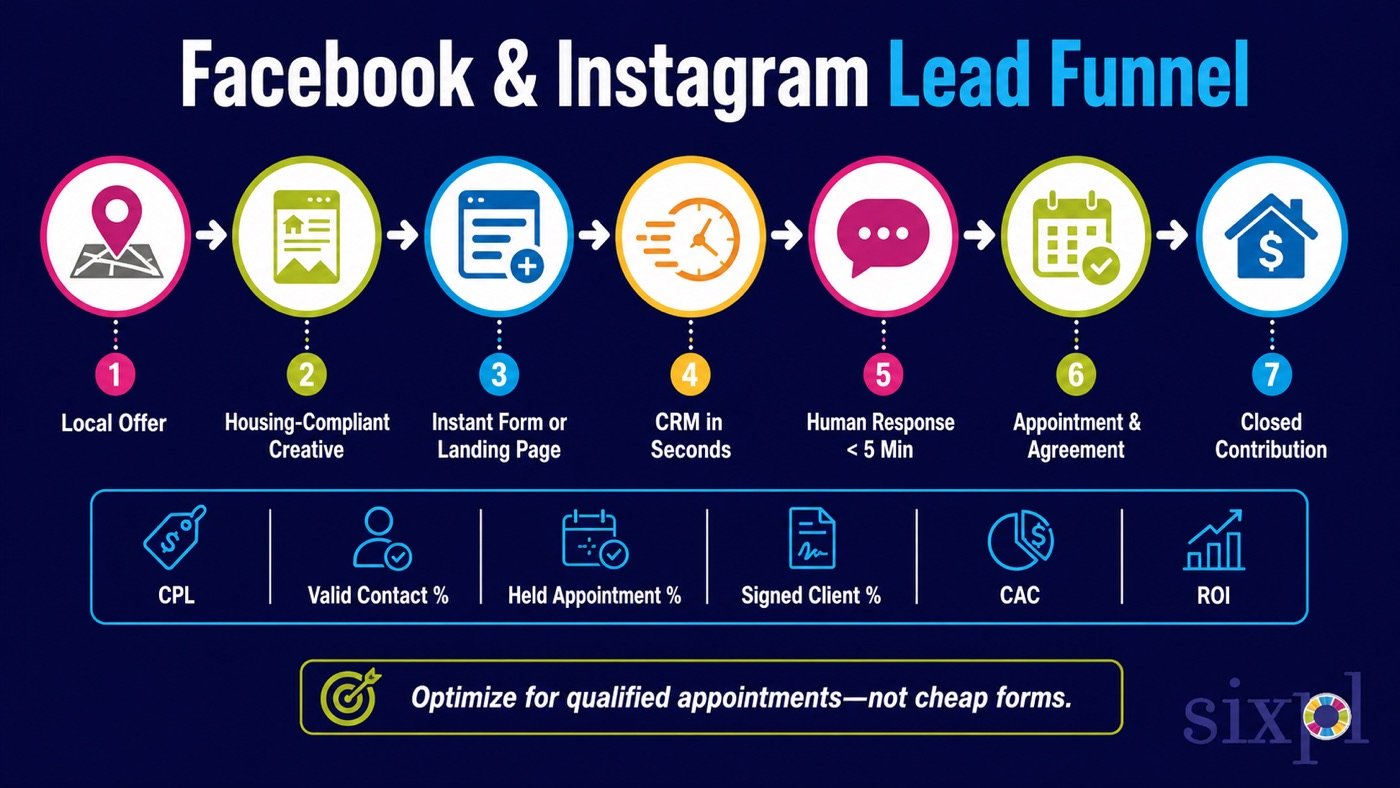
- Offer: property list, price reduction alert, relocation guide, seller equity/range consultation, open-house registration, or first-time-buyer workshop. Avoid bait that misrepresents availability.
- Creative: one local claim, visible place cue, specific benefit, subtitles, and multiple formats. First-hand vertical video often outperforms polished generic stock because it proves locality.
- Capture: instant forms reduce friction; landing pages add context, analytics, qualification, and owned consent. Test both on cost per qualified appointment, not form completion.
- Qualification: timeline, location, representation status, financing status where appropriate, and preferred contact method. Ask only what changes routing.
- Response: immediate confirmation; human call/text within five minutes during covered hours; repeated, respectful attempts over 10–14 days; then long nurture.
- Nurture: listings and education matched to intent, not a generic drip. Move the consumer when behavior changes.
- Measurement: offline conversion upload where permitted, CRM source lock, first/last-touch views, and a 12–18 month cohort.
Planning benchmarks
| Stage | Weak | Workable | Strong | Diagnostic |
|---|---|---|---|---|
| Form CPL | <$20 can still be weak | $20–$60 | Context-dependent | Do not celebrate alone |
| Valid contact rate | <50% | 50–75% | >75% | Form quality/offer |
| Two-way conversation | <20% | 20–40% | >40% | Speed, data, script |
| Appointment set / raw lead | <3% | 3–10% | >10% | Qualification/value |
| Appointment held / raw lead | <2% | 2–7% | >7% | Confirmation and intent |
| Close / raw lead | <0.5% | 0.5–2% | >2% | Cohort must mature |
These are operating ranges, not externally audited national averages. Seller, buyer, relocation, luxury, and listing-specific campaigns should never share one benchmark.
Budget and experiment design
A useful test needs enough spend to generate a decision-sized sample. At a $35 CPL, 60 leads cost $2,100 before creative and labor. A $300 “test” can reject a creative but rarely establishes CAC. Solo agents should budget $1,500–$3,500 per month only if they can cover response and sustain 90 days; teams may spend $5,000–$25,000+ after cohort economics work.
Common failure modes
- Optimizing for the cheapest form submission rather than qualified appointments.
- Promising a “list” that is merely an IDX search anyone can obtain.
- No fair-housing review. Housing ads must use Meta’s applicable Special Ad Category and restricted targeting.
- Ads and CRM disagree on consent or source.
- Lead delivery goes to email instead of an immediate routing system.
- One agent receives leads while showing homes and cannot respond.
- Retargeting audiences are too small, stale, or policy-ineligible.
- Creative runs unchanged until fatigue.
- The team counts a closing in the month it closes instead of the acquisition cohort.
Modeled case study—not a claimed client result
A team spends $4,200 media + $800 creative/management and produces 120 leads ($35 media CPL; $41.67 fully loaded). Seventy-two are valid, 30 converse, eight hold appointments, four sign, and two close. Marketing CAC is $2,500 per close. If contribution per close after brokerage/referral/transaction costs is $7,500, marketing contribution is $10,000 and marketing ROI is ($15,000 − $5,000) / $5,000 = 200%. If only one closes, ROI falls to 50%. If no second closing appears within the attribution window, scaling is unjustified.
8. LinkedIn
LinkedIn is a poor default channel for mass residential-buyer advertising and a strong niche channel for relocation, executive clients, luxury credibility, commercial real estate, investors, builders, attorneys, CPAs, and agent referrals.
The organic system is straightforward: optimize the headline around market and client, publish one original local or transaction insight weekly, comment intelligently on local business posts, connect after genuine context, and use a monthly newsletter. A message should reference a shared issue and offer a useful resource—not pretend a cold pitch is networking.
Sales Navigator helps find role, company, geography, and change signals, but exporting or automating indiscriminate messages creates account and reputation risk. Paid LinkedIn usually has higher CPC/CPL than Meta; it earns a place only when client value and professional targeting justify it. Start organic. Track introductions, replies, consultations, and closed GCI. Best users: commercial specialists, corporate-relocation agents, luxury agents with evidence, and team leaders recruiting deliberately.
9. Google Ads
Search captures declared intent and is therefore usually more expensive and higher quality. WordStream’s 2025 search benchmark reported real estate at 8.43% CTR, 3.28% conversion rate, and $100.48 CPL. The same dataset implies an approximate $3.30 CPC from CPL × conversion rate; market-specific seller terms can cost far more.
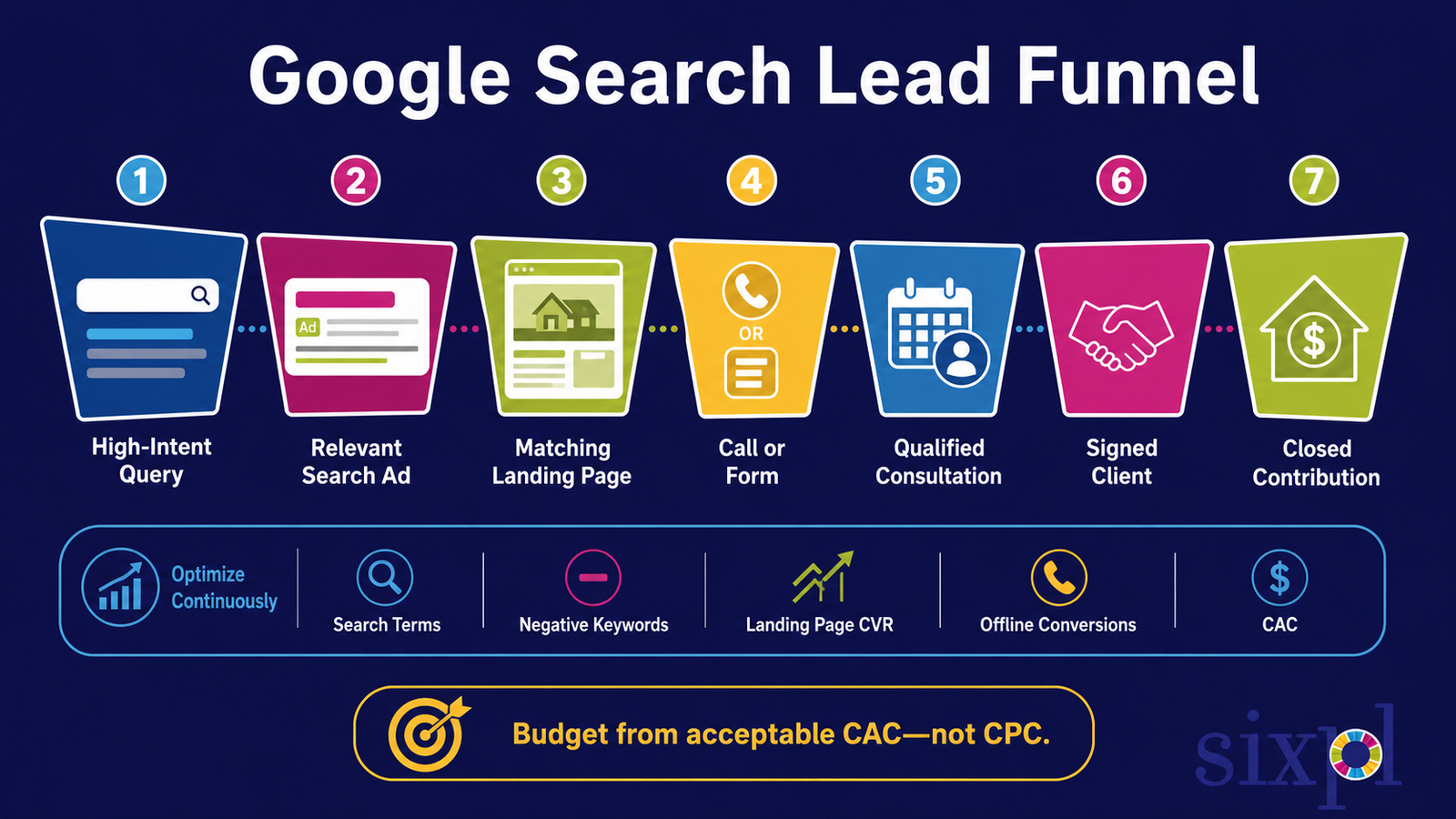
Campaign architecture
- Separate seller valuation, buyer/IDX, relocation, brand, neighborhood, and competitor intent.
- Use tight geography and location settings; exclude irrelevant intent.
- Match the landing page to the query and disclose brokerage, licensing, privacy, and consent.
- Use call tracking, form tracking, CRM source IDs, and offline qualified/closed conversions.
- Maintain negative keywords: jobs, license, course, salary, free, rent when irrelevant, wholesale when irrelevant, Zestimate support, and informational queries without business value.
- Protect the branded campaign but measure whether organic would have captured the click.
Google’s housing advertising policy restricts U.S./Canada targeting by gender, age, parental/marital status, and ZIP code; compliant city/country and radius targeting is allowed under stated conditions. Review current policy before launch.
Local Services Ads and Home Listings Ads
Real estate agents are currently an eligible U.S. Local Services Ads category. The product charges for leads rather than clicks and requires screening that may include license verification. Google also requires a public, verified, matching Business Profile. Real-estate advertisers cannot target by postal code. Availability, lead price, disputes, badges, and verification remain market- and account-specific.
In 2026 Google expanded Home Listings Ads nationwide on U.S. mobile search. The format can show HouseCanary-powered property information alongside promoted buyer agents; opting into buyer’s-agent or seller’s-agent job types controls eligibility. The dashboard reports impressions, lead volume, impression share, and spend, but does not provide an ad-format breakdown. Treat LSA as a separate cohort from conventional search ads, answer promptly, review charged leads under current rules, and calculate cost per held appointment and close. Dynamic market pricing makes a universal CPL claim unreliable.
Budget logic
At a $100 benchmark CPL, $2,000 may buy roughly 20 leads. At a 3% lead-to-close rate, that is 0.6 expected closings—not enough to infer performance in one month. A three-month, $6,000 test with 60 leads is still statistically thin but operationally useful. Set the budget from acceptable CAC:
Maximum CPL = contribution per close × target marketing share × lead-to-close rate.
If contribution is $8,000, the business will spend at most 25% on acquisition, and lead-to-close is 3%, maximum CPL is $60. A $100 campaign cannot work without improving conversion, contribution, or downstream referral value.
10. SEO, Maps, and AI search
SEO is not “write four blogs a month.” It is the creation of the best accessible answer for a local problem, supported by technical quality, entities, evidence, links, reviews, and a recognizable expert.
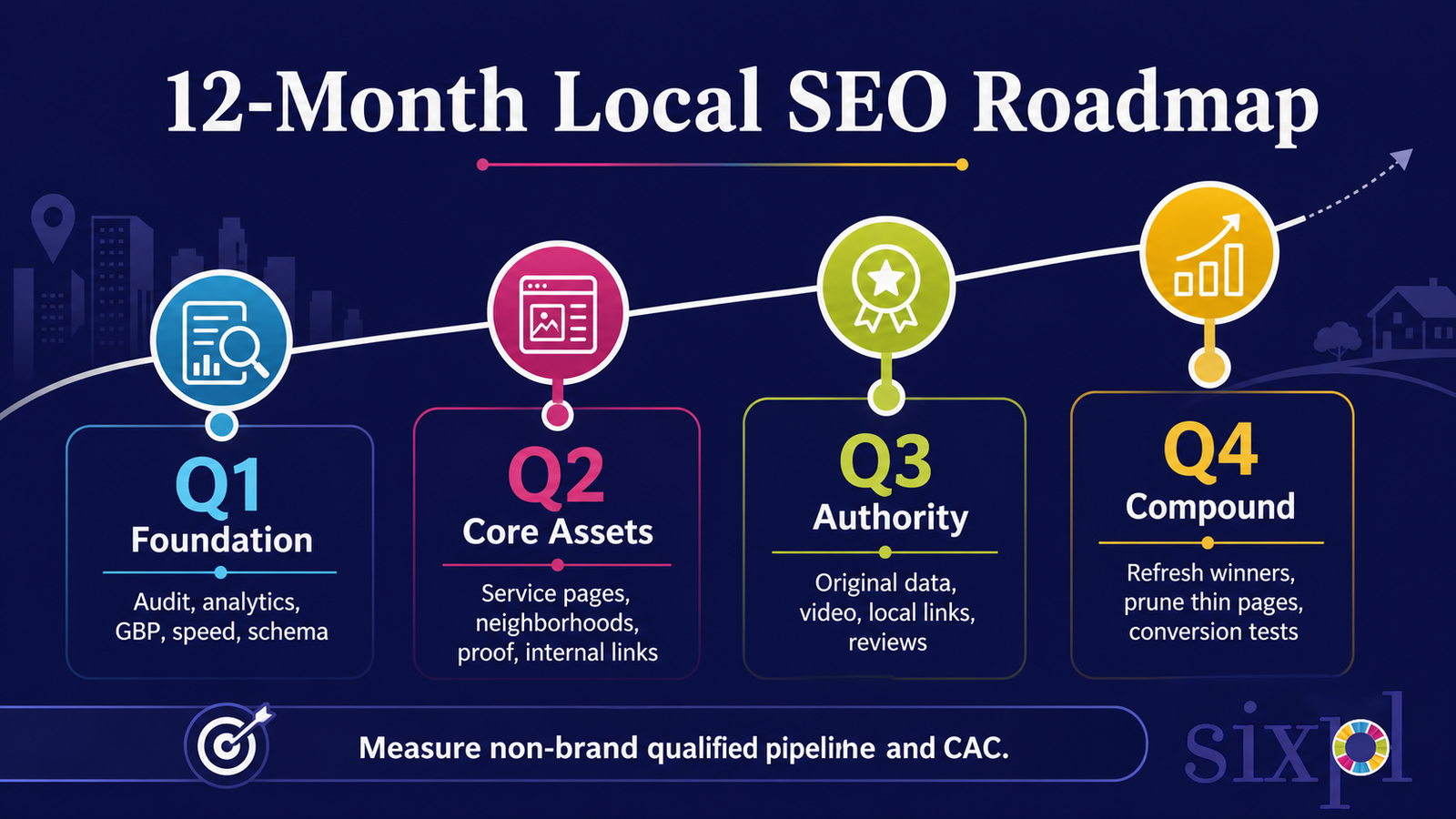
12-month roadmap
Months 0–2: crawl/index audit; analytics; Search Console; GBP cleanup; speed; mobile UX; schema; brokerage and licensing disclosures; conversion tracking; keyword-to-page map.
Months 2–4: core city/service pages, buyer/seller pages, team bios, proof, neighborhood template, internal linking, citation cleanup.
Months 4–8: original neighborhood guides, market datasets, schools and fair-housing-safe lifestyle information, videos, local links, digital PR, review system.
Months 8–12: refresh winners, prune/merge thin pages, create comparison and relocation resources, test conversion, and measure assisted leads.
Expect 6–12 months for meaningful competitive non-brand results; a new domain in a major metro may take longer. Typical outside investment ranges from $1,500–$5,000 monthly for a focused solo/local program to $5,000–$20,000+ for a competitive multi-market organization. The correct metric is non-brand qualified pipeline and CAC by landing page cohort.
Neighborhood content that earns attention
Publish first-hand photos/video, commute methodology, housing stock, price and inventory series, zoning/development sources, amenities, property taxes with official links, flood/fire/insurance sources, and a clear “who this fits” framework that avoids steering or protected-class implications. Update timestamps and retain methodology.
AI search optimization
There is no separate magic “AI SEO.” Make claims extractable and attributable: concise answers, descriptive headings, tables, author identity, dates, citations, original data, consistent business entities, and pages that render without scripts. Track citations and branded-search growth, but do not assume an AI mention sends a click. Build email/video/direct demand alongside search.
11. YouTube
YouTube compounds because it serves discovery, search, trust, and sales enablement. High-value formats are relocation guides, neighborhood comparisons, cost-of-living breakdowns, “what $X buys,” new-construction tours with permission, homeowner explainers, and measured market updates.
A phone, wireless microphone, small light, tripod, and competent editing are enough; $300–$1,500 can create a credible starter kit. Publish one useful long video weekly or biweekly for at least six months, then cut truthful short clips. Titles should promise a concrete local answer; thumbnails should communicate one idea. Each video needs a next step matched to intent.
Measure qualified calls, email opt-ins, consultation bookings, signed agreements, and closed contribution tagged to first discovery. Do not value the channel solely by subscribers. A 2,000-view relocation video that creates one $10,000 contribution client can outperform a 100,000-view entertainment clip.
12. Realtor technology stack
Buy the minimum system that the team will use. Overlapping all-in-one platforms create duplicate records, consent errors, and broken attribution. Prices below are indicative public-entry ranges observed around the research cutoff; vendors change packaging, usage fees, contacts, and contracts. Verify on linked pricing pages.
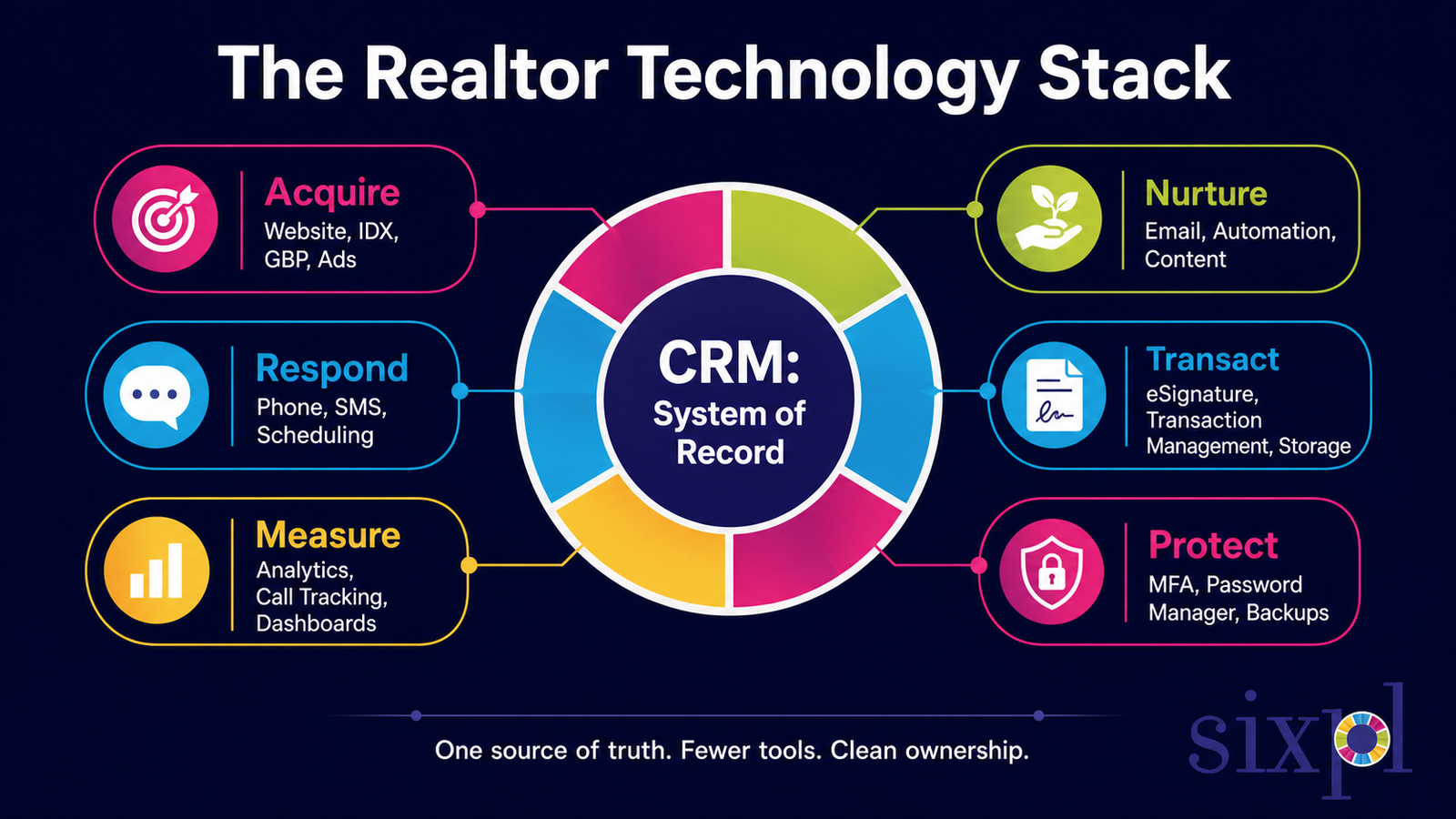
| Function | Practical options | Indicative price | Best for | Main drawback / alternative |
|---|---|---|---|---|
| CRM | Follow Up Boss; HubSpot; LionDesk/market alternatives | Free to $100+/user/mo | HubSpot for flexible free start; FUB for real-estate teams | Automation and dialer costs; audit portability |
| Website/CMS | WordPress; Webflow; brokerage site | $20–$500+/mo plus build | Owned content | Maintenance; managed real-estate platform alternative |
| IDX | IDX Broker, iHomefinder, Showcase IDX, local vendors | ~$60–$200+/mo plus MLS fees | Listing search/alerts | Thin-page SEO and MLS variability |
| Google Workspace; Microsoft 365; Mailchimp; ActiveCampaign | $7–$150+/mo | Professional identity and nurture | Contact-based pricing and deliverability | |
| SMS/phone | Twilio, OpenPhone, Dialpad, CRM dialer | $15+/user plus usage | Consent-based response | TCPA, registration, recording law |
| Automation | Native CRM; Zapier; Make | $0–$100+/mo | Routing and data movement | Silent failures; minimize complexity |
| Scheduling | Calendly; Google appointment scheduling | $0–$20+/seat/mo | Consultation booking | No substitute for qualification |
| Call tracking | CallRail | From $50/mo + usage | Source attribution | Dynamic-number and consent configuration |
| Analytics | GA4; Search Console; Looker Studio | Free | Web and reporting baseline | Attribution gaps |
| Heatmaps | Microsoft Clarity; Hotjar | Free–$100+/mo | UX diagnosis | Privacy/redaction configuration |
| AI chatbot | HubSpot, Intercom, CRM/site vendors | Free–$500+/mo + usage | FAQ and routing | Hallucination, disclosure, fair-housing risk |
| AI receptionist | CallRail Voice Assist; Smith.ai; specialist vendors | ~$95–$1,000+/mo | Missed-call capture | Monitor scripts, escalation, consent |
| Video | Phone + Descript/CapCut/Premiere | $0–$60+/mo | Local video | Production consistency |
| Design/social | Canva; Adobe; Buffer/Later | $0–$100+/mo | Brand templates and scheduling | Generic AI content |
| Reputation | GBP native link; Birdeye/Podium | Free–$500+/mo | Review requests at scale | Gating and platform lock-in risk |
| Project management | Trello; Asana; ClickUp | Free–$30/user/mo | Content/operations | Another unused system |
| Accounting | QuickBooks; Xero | $20–$100+/mo | P&L and tax organization | Requires clean bookkeeping |
| eSignature | Dotloop; DocuSign; SkySlope Forms | Often brokerage-included or $20–$50+/mo | Agreements | State/form-library differences |
| Transaction management | Dotloop, SkySlope, Brokermint, reZEN | Included–$100+/user/mo | Compliance workflow | Brokerage mandates |
| Cloud storage | Google Workspace; Microsoft 365 | Often bundled | Controlled sharing | Poor permission hygiene |
| Cybersecurity | Password manager + MFA + endpoint backup | $10–$50/user/mo | Everyone | Training and process still required |
Minimum viable stack for a solo agent
One professional domain/email, one CRM, one phone/SMS system, one booking link, brokerage-approved forms/e-signature, accounting, secure cloud storage, password manager with MFA, analytics, and a simple website/GBP. Add IDX, advanced automation, call tracking, and AI only when a measured workflow requires them.
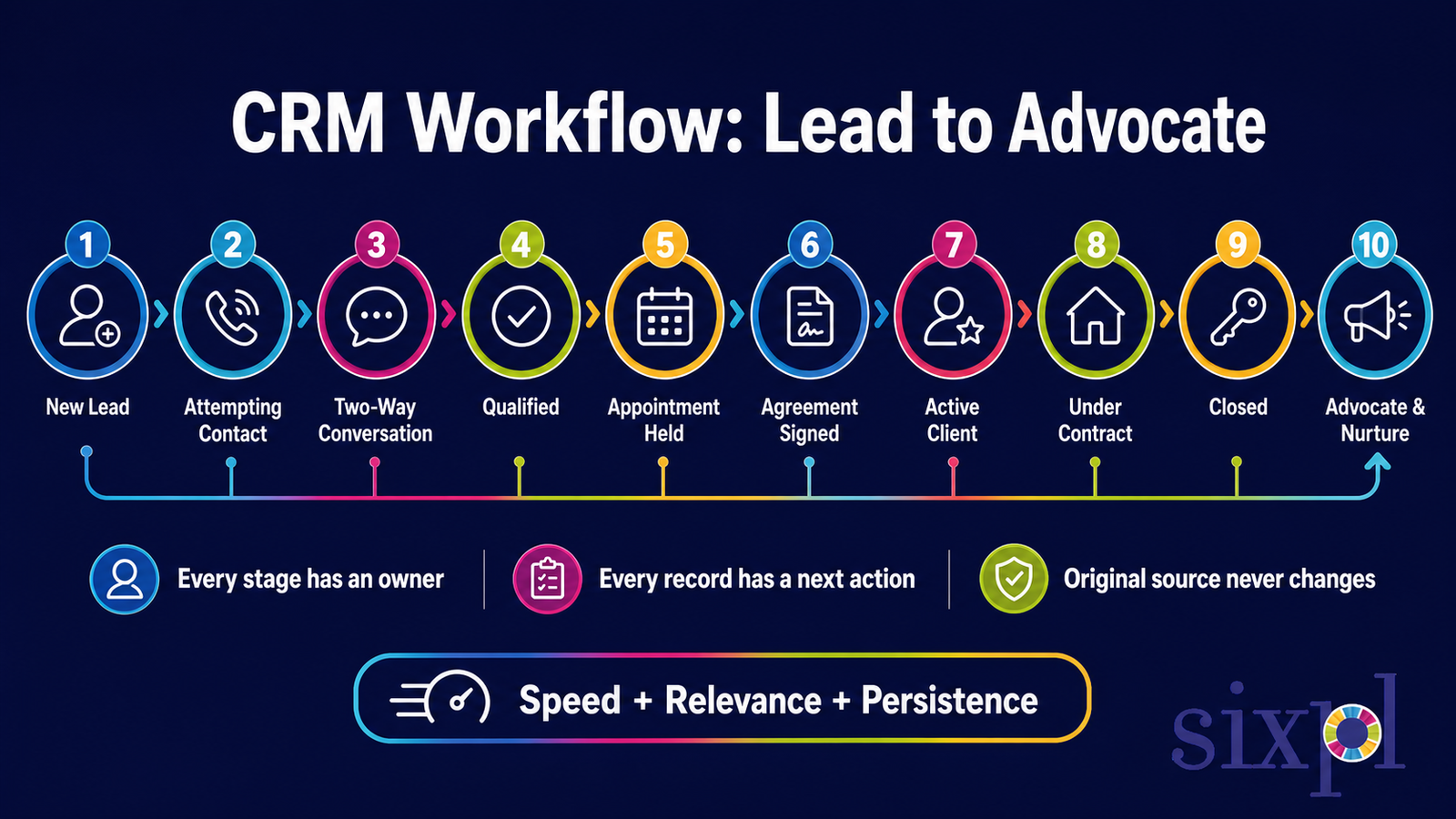
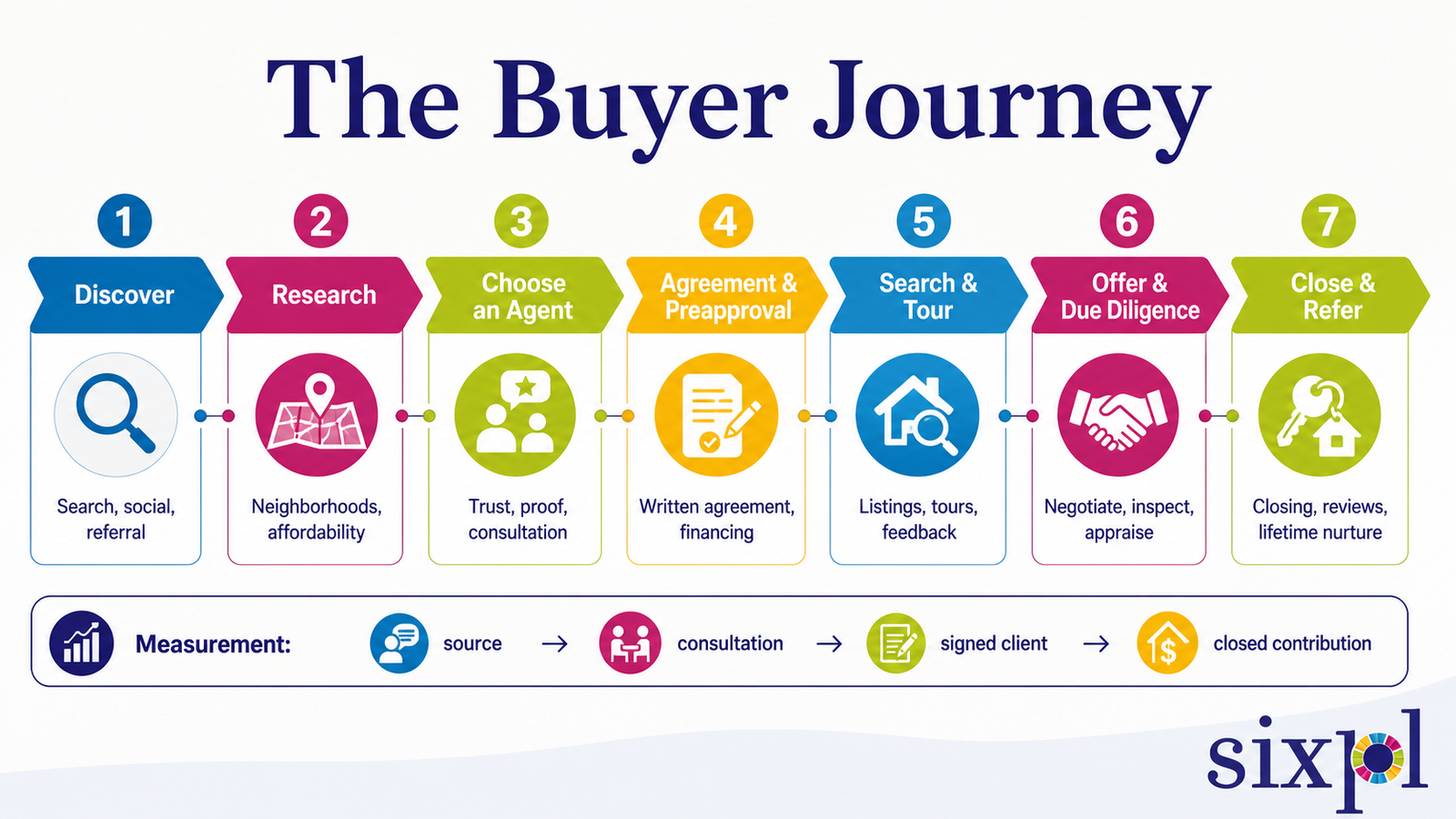
Lead states: New → Attempting contact → Two-way conversation → Qualified → Appointment set → Appointment held → Agreement signed → Active client → Under contract → Closed → Advocate / nurture. Every state needs an owner, next action, due date, and exit rule.
13. Marketing budget benchmarks
Budgets are planning models, not industry averages. NAR’s median 2025 marketing-service spend was only $950 annually, but median spend is distorted by zero-spenders and is incompatible with a scaled paid strategy.
| Profile | Monthly total | Relationship/community | Owned web/SEO/GBP/content | Paid media/portals | CRM/tech/data | Measurement/creative/contingency |
|---|---|---|---|---|---|---|
| Brand-new agent | $750 | $250 | $150 | $0 | $200 | $150 |
| 1–3 years, some closings | $2,500 | $600 | $600 | $700 | $300 | $300 |
| Established top producer | $8,000 | $1,500 | $2,000 | $2,800 | $700 | $1,000 |
| Luxury specialist | $15,000 | $3,000 | $4,000 | $4,000 | $1,000 | $3,000 |
| Team leader | $25,000 | $3,000 | $4,000 | $12,000 | $3,000 | $3,000 |
| Independent brokerage | $60,000 | $8,000 | $10,000 | $24,000 | $10,000 | $8,000 |
New agents should replace cash with structured time: open houses, sphere conversations, community work, local video, and database hygiene. They should not finance speculative leads with debt. Established businesses can spend more because historical conversion and cash reserves reduce risk. Keep at least six months of fixed business expense and never commit the entire budget to a vendor contract before a cohort proves economics.
14. Economics of lead generation
Definitions
- CPL: channel spend ÷ raw leads.
- Cost per valid lead: spend ÷ leads with usable, genuine contact information.
- Cost per appointment: spend ÷ held appointments (state whether set or held).
- CAC: all acquisition cost ÷ new closed clients. Include media, referral fees, agency, creative, data, ISA/sales labor, and allocated software.
- Contribution per close: GCI minus brokerage/team/referral/transaction fees and incremental client-servicing cost.
- Marketing ROI: (attributed contribution − acquisition cost) ÷ acquisition cost.
- Payback: time from acquisition spend to collected contribution.
- LTV: risk-adjusted present value of current contribution plus repeat and referral contribution. Do not count hypothetical referrals as guaranteed.
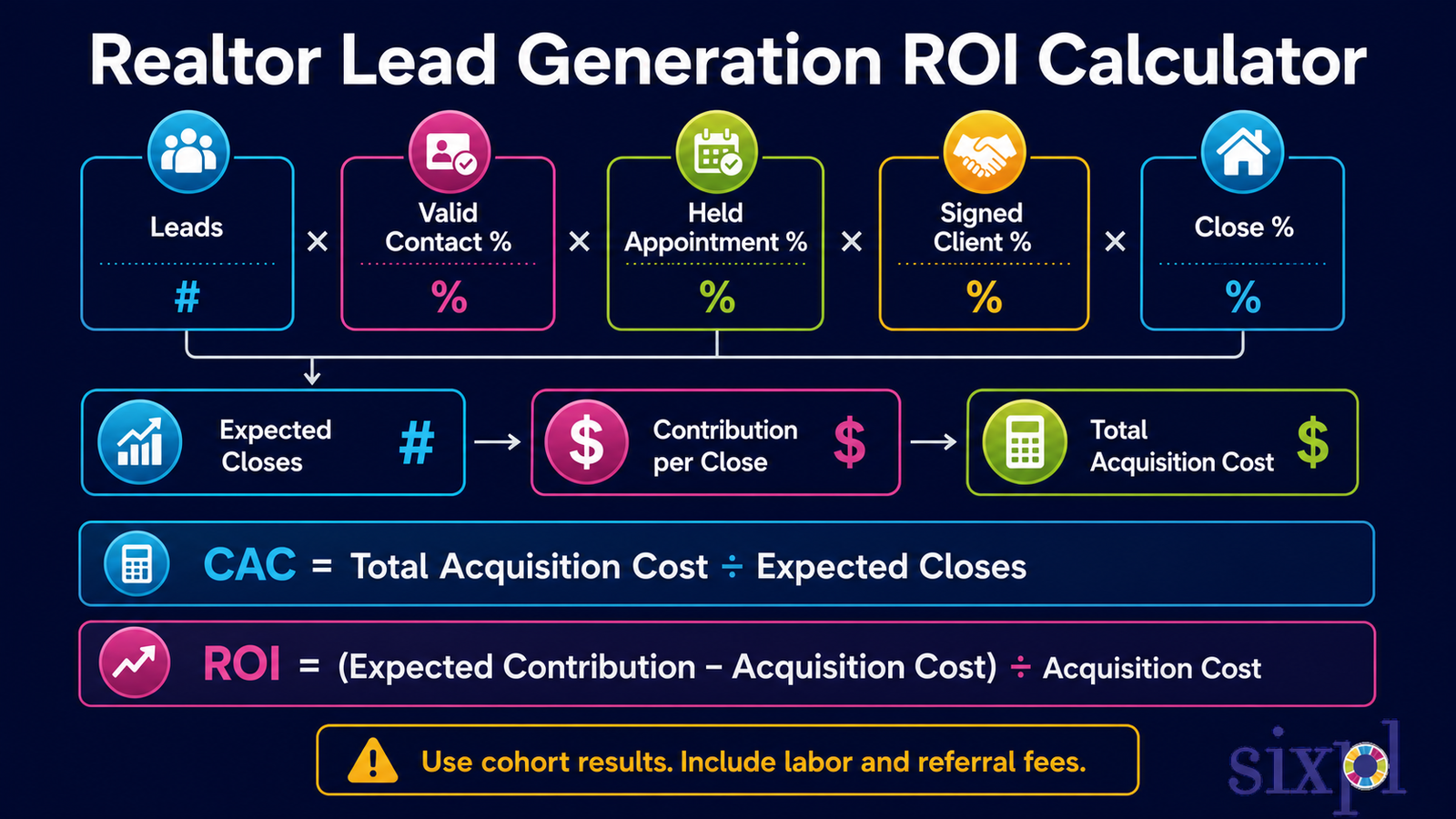
Funnel calculator
Let:
L= leadsc= valid contact ratea= appointment-held rate among valid contactss= signed-client rate among held appointmentsq= close rate among signed clientsM= contribution margin per closeC= total acquisition cost
Expected closes = L × c × a × s × q
Expected contribution = expected closes × M
CAC = C ÷ expected closes
ROI = (expected contribution − C) ÷ C
Comparable channel model
The following is a transparent scenario, not a national benchmark. It uses one $8,000 contribution closing value and prices labor where relevant.
| Channel | All-in cost | Leads/opportunities | Expected closes | CAC | Expected contribution | ROI |
|---|---|---|---|---|---|---|
| Past-client program | $2,000 | 20 warm opportunities | 4.0 | $500 | $32,000 | 1,500% |
| Open houses | $3,000 incl. labor | 60 | 2.0 | $1,500 | $16,000 | 433% |
| Google Ads | $10,000 | 100 | 3.0 | $3,333 | $24,000 | 140% |
| Meta ads | $6,000 | 180 | 1.8 | $3,333 | $14,400 | 140% |
| Portal success fee | 35% of $10,000 GCI × 3 closes | 3 closings | 3.0 | $3,500 | Depends on remaining margin | Must model waterfall |
| Cold outreach | $7,500 incl. labor/data | 1,500 records | 1.5 | $5,000 | $12,000 | 60% |
This table illustrates sensitivity, not superiority. Change close rate by one percentage point and the ranking may reverse. Relationship ROI is often overstated because agents price their labor at zero and ignore years of service.
Buyer versus seller economics
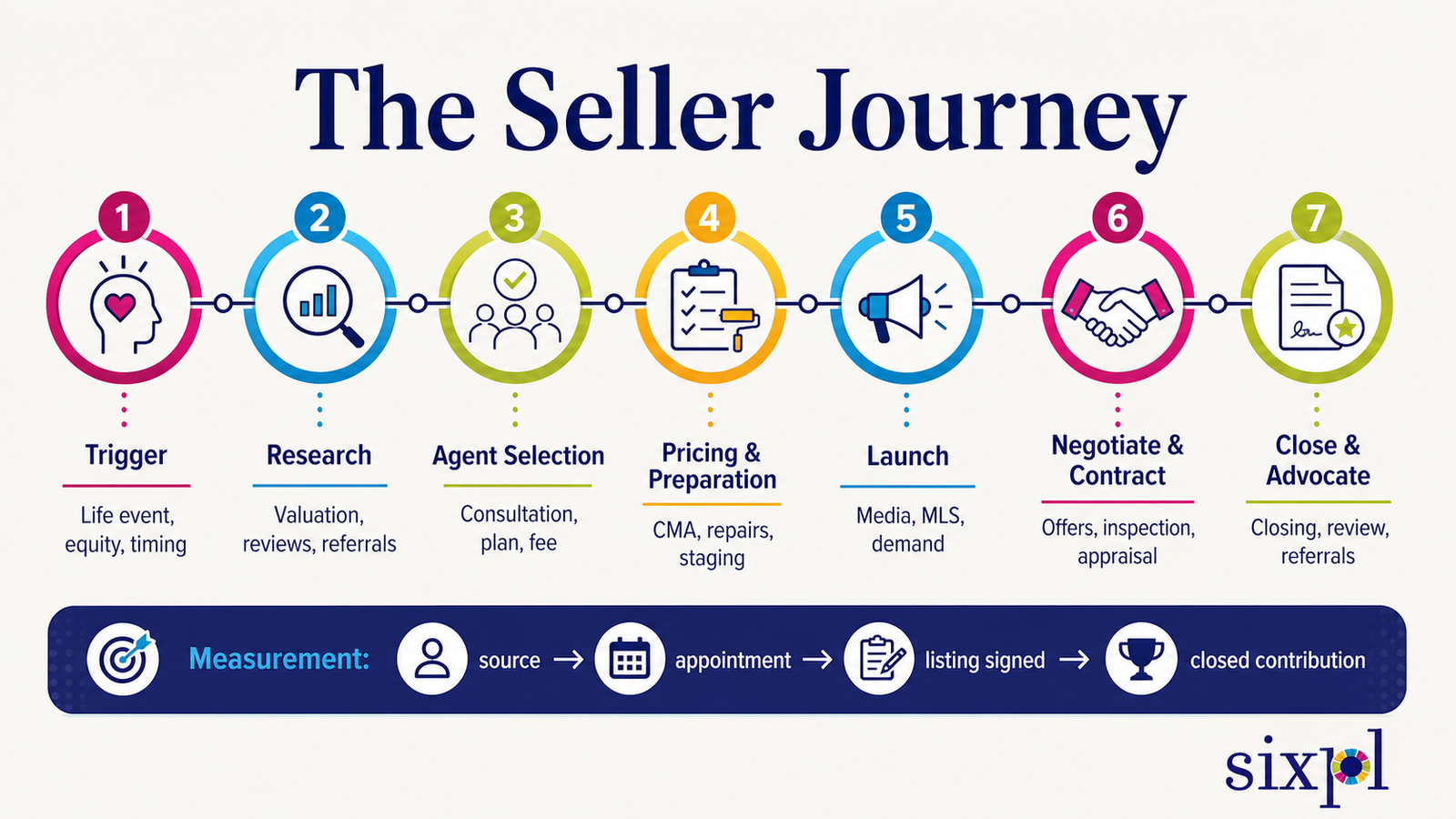
Seller acquisition may have higher CPC and appointment cost but can create listing inventory, sign calls, neighbors, buyers, and brand exposure. Buyer leads may be more numerous but require showings, failed offers, financing work, and long nurture. Track separately:
| Cost | Buyer | Seller |
|---|---|---|
| Acquisition | Media + ISA + nurture | Media/prospecting + valuation/consultation |
| Service | Showing time, travel, offers | Staging advice, media, launch, open houses |
| Failure risk | Financing, inventory, agreement | Pricing, withdrawal, expiration |
| Secondary value | Future listing/referrals | Listing-generated buyers and neighborhood proof |
Attribution rules
- Lock original source; separately store latest source.
- Use a 12–18 month view for consumer leads.
- Attribute referral fees to acquisition, not cost of goods hidden elsewhere.
- Report by acquisition cohort, not closing month.
- Reconcile CRM closings to commission statements.
- Show cash CAC and labor-adjusted CAC.
- Publish sample size and uncertainty.
- Stop channels on negative contribution, not temporary CPL noise.
Decision tree
Is attribution trustworthy?
├─ No → Fix source capture, stages, and revenue reconciliation.
└─ Yes → Is the cohort mature enough?
   ├─ No → Maintain test; do not scale.
   └─ Yes → Is contribution/CAC above the required threshold?
      ├─ No → Diagnose offer → contact → appointment → agreement → close.
      └─ Yes → Can operations absorb 2× volume without slower response?
         ├─ No → Add capacity first.
         └─ Yes → Increase budget 15–30%, then remeasure.
15. AI for Realtors
AI is best used as an assistant inside controlled workflows, not as an unsupervised licensee.
High-value current uses
- Summarize calls and extract next actions into the CRM with consent.
- Draft listing descriptions from verified facts, then human-check every claim.
- Segment the database by stated need and engagement; do not infer protected traits.
- Turn a recorded market explanation into email, short video, FAQ, and page drafts.
- Compare documents and check completeness, without replacing broker/legal review.
- Qualify inbound inquiries using a disclosed chatbot or voice system and escalate promptly.
- Generate first drafts of CMAs, neighborhood tables, and campaign variants from sourced data.
- Detect stale leads, overdue tasks, duplicate records, and missing attribution.
Prompt pattern
Role: You are assisting a licensed U.S. real-estate professional.
Task: [specific deliverable]
Sources: Use only the attached MLS export, county source, and brokerage-approved facts.
Constraints: Do not infer protected-class characteristics; do not give legal/tax advice;
do not invent property facts; flag uncertainty; preserve required disclosures.
Output: [format, length, reading level]
Verification: List every numeric claim with its source and date.
Risk controls
Human review is mandatory for fair housing, advertising claims, contracts, pricing advice, property facts, confidential data, and communications that bind a client. Minimize personal data sent to models, sign appropriate vendor agreements, define retention, restrict integrations, test for prompt injection, and keep an audit trail. Never let a voice agent pretend to be a human. AI-generated photos must not misrepresent the property.
Near-term outlook
CRM systems will move from passive databases to action systems: summarizing conversations, suggesting next best actions, handling routine inbound calls, and forecasting likelihood. Generic content will approach zero marginal cost. The advantage will shift toward proprietary local evidence, permissioned data, trusted identity, fast human judgment, and well-instrumented operations.
16. Roadmap for aspiring Realtors
Licensing and startup reality
Every state sets education, exam, background, sponsorship, and renewal rules. Use the state regulator linked through NAR’s licensing resource and verify requirements directly; course-provider summaries become stale.
A defensible startup budget is $2,000–$8,000 before living expenses: education/exam/license, background check, association/MLS/lockbox, brokerage onboarding, insurance/fees, basic technology, signs/cards, and launch marketing. High-fee markets and paid leads can exceed it. Maintain 6–12 months of personal runway. NAR’s evidence—$8,000 median gross income and two median sides for members with ≤2 years—makes quitting stable employment without runway hazardous.
Brokerage selection priorities
Choose supervision, contract training, live help, field exposure, and transparent economics ahead of headline split. A new agent needs someone to review an offer at 8 p.m., not merely a video library. Join a productive team only after understanding lead source, team split, brokerage split, showing duty, ownership of clients, and exit terms.
First 30 days
- Complete licensing, brokerage, MLS, forms, safety, fair-housing, and cybersecurity setup.
- Build a clean CRM of people who know you; obtain appropriate contact permission.
- Conduct 50 personal conversations focused on learning and service, not an announcement blast.
- Shadow consultations, showings, inspections, negotiations, and closings.
- Prepare buyer-agreement and listing-presentation explanations.
- Claim compliant profiles and create a simple proof-based website page.
- Schedule two open houses and three local-partner meetings.
Days 31–90
- Hold 8–12 open houses or equivalent live opportunities.
- Publish 12 useful local videos/posts and one substantial neighborhood resource.
- Run weekly role-play and contract review.
- Establish a daily prospecting block and same-day CRM completion.
- Measure conversations, appointments held, agreements, active clients, and pipeline value.
- Do not buy leads until manual follow-up is consistent.
Months 4–12
- Select one niche based on actual conversations and economics.
- Build three engines: sphere/referral, live/community, and owned digital.
- Add paid acquisition only with a budget, tracking, and 90-day test protocol.
- Review P&L and pipeline monthly; reserve taxes; calculate hourly economics.
- Target process outcomes—conversations, appointments, agreements—and let closings lag.
Common mistakes
Buying branding before learning contracts; selecting a broker on split alone; confusing social reach with pipeline; changing channels every month; failing to ask representation status; ignoring database consent; spending personal runway on shared portal leads; and treating unverified AI output as expertise.
17. The 100-point Realtor growth scorecard
Answer yes only when evidence exists. One point each.
Positioning and brand (1–10)
- Can a stranger identify my market and ideal client in ten seconds?
- Do I have a defensible specialization beyond “great service”?
- Is my name, brokerage, and licensing disclosure consistent everywhere?
- Do I own my primary domain?
- Do I own/control my professional email?
- Do I have current professional photos and biography?
- Does my proof include specific, permitted outcomes rather than vague claims?
- Is every testimonial authentic and permissioned?
- Can I explain my buyer-agent value before a tour?
- Can I explain my listing plan and fee without disparaging competitors?
Database and referrals (11–20)
- Is every relationship in one CRM?
- Is original source locked?
- Is each contact tagged by relationship and likely need?
- Is consent/status recorded for email and SMS?
- Does every active record have a next action and date?
- Do I contact priority relationships meaningfully each quarter?
- Do I provide an annual homeowner/equity review?
- Do I have a closing-to-review workflow?
- Do I have a closing-to-referral-introduction workflow?
- Do I measure repeat and referral contribution separately?
Follow-up and sales (21–30)
- Are new paid leads acknowledged instantly?
- Can a human respond within five minutes during coverage hours?
- Is after-hours routing explicit?
- Are lead stages objectively defined?
- Is appointment “set” separate from “held”?
- Are signed clients separate from active prospects?
- Are scripts diagnosis-led and compliant?
- Are calls reviewed or coached with consent?
- Is long-term nurture at least 12 months?
- Do lost leads have standardized reasons?
Website and conversion (31–40)
- Is the website mobile-fast and secure?
- Does each campaign have a matching landing page?
- Are brokerage and licensing disclosures current?
- Are privacy and consent notices clear?
- Is contact possible by phone, form, and accessible alternatives?
- Are calls and forms tracked to source?
- Does the site contain original local evidence?
- Are thin IDX/filter pages controlled?
- Can content and data be exported?
- Are forms and key journeys tested monthly?
Local SEO and reputation (41–50)
- Is my GBP individually eligible and brokerage-approved?
- Is the real-world name used without keyword stuffing?
- Is the address/storefront/service-area configuration compliant?
- Are categories, hours, phone, and website accurate?
- Are duplicate listings resolved?
- Do I request reviews neutrally from all eligible clients?
- Do I respond without disclosing confidential facts?
- Are local citations consistent?
- Do I earn real local links/mentions?
- Do I track GBP calls, clicks, and qualified outcomes?
Content, video, and social (51–60)
- Does every content series serve a defined client question?
- Do I publish first-hand local material?
- Are statistics sourced and dated?
- Is one long-form asset repurposed efficiently?
- Is video audio clear and captioned?
- Is publishing consistent for at least six months?
- Does each asset offer a relevant next step?
- Do I avoid protected-class steering language?
- Do I measure pipeline rather than vanity metrics?
- Do I archive content rights and source files?
Paid acquisition (61–70)
- Is each campaign tied to an acceptable CAC?
- Is the offer accurate and locally relevant?
- Are housing-ad targeting restrictions followed?
- Are negative keywords/exclusions maintained?
- Are creative tests documented?
- Are valid contact and held-appointment rates reported?
- Are cohorts tracked 12–18 months?
- Are referral fees included in CAC?
- Are agency, creative, data, and ISA labor included?
- Is there a written scale/stop rule?
Technology and automation (71–80)
- Is there one system of record?
- Are integrations mapped and owned?
- Are failed automations monitored?
- Are duplicates routinely merged?
- Can data be exported without vendor help?
- Is least-privilege access used?
- Is MFA enabled on email, CRM, MLS, and ad accounts?
- Are password managers mandatory?
- Are backups and recovery tested?
- Are AI outputs reviewed before client use?
Operations and client experience (81–90)
- Does every active client have a documented service plan?
- Are response expectations explained?
- Are showing and safety procedures defined?
- Are transaction milestones automated but human-owned?
- Is client data shared only as needed?
- Are vendor relationships disclosed and compliant?
- Is post-closing service scheduled?
- Are complaints logged and resolved systematically?
- Is capacity measured before adding leads?
- Is there coverage for absence and emergencies?
Finance and analytics (91–100)
- Is business and personal money separated?
- Is a monthly P&L closed accurately?
- Are taxes and reserves funded?
- Is GCI reconciled to closings?
- Is contribution per buyer and seller known?
- Is CAC known by channel and cohort?
- Is cash CAC separate from labor-adjusted CAC?
- Is payback period measured?
- Are repeat/referral assumptions discounted rather than guaranteed?
- Can I name the next dollar I would cut and the next dollar I would scale?
Score interpretation
| Score | State | Action |
|---|---|---|
| 0–39 | Fragile | Stop adding channels; fix compliance, CRM, response, and finance |
| 40–59 | Functional | Standardize follow-up and attribution; build one owned engine |
| 60–79 | Scalable | Improve conversion bottlenecks; run controlled paid tests |
| 80–90 | High-performing | Optimize contribution, capacity, and defensibility |
| 91–100 | Institutional | Audit quality, security, succession, and diminishing returns |
18. Future of the industry
What is likely to grow
- Conversational search and answer engines: fewer routine clicks, more value in cited local data and branded demand.
- AI-assisted response: call transcription, qualification, routing, next action, and database reactivation become standard.
- First-party data: permissioned CRM histories become more valuable as targeting and tracking restrictions grow.
- Proof-based personal brands: reviews, transaction literacy, and first-hand media outlast generic posting.
- Specialization: relocation, probate/estate, new construction, investor underwriting, senior transitions, and complex local niches reward expertise—subject to licensing and legal limits.
- Transparent service packaging: written buyer agreements create room for clearer tiers, retainers, rebates where legal, and fee-for-service experiments.
- Data interoperability: RESO APIs and better integrations reduce manual re-entry, though local rules remain fragmented.
What is likely to decline
Thin AI blogs, undifferentiated IDX sites, scraped email, noncompliant automated calling/texting, vanity-metric social strategies, generic portal-speed scripts, and broker platforms that trap agent data. Cold outreach will not disappear, but privacy, carrier filtering, consumer fatigue, and labor economics will make careless volume less viable.
The durable agent advantage
AI can draft, summarize, route, and calculate. It cannot assume fiduciary responsibility, inspect the local reality behind a dataset, negotiate with accountability, or lend an earned reputation. The winning operating model is therefore automation around judgment, not automation instead of judgment.
Final chapter: when an integrated growth partner makes sense
An agent should not hire an agency to avoid selling, serving, or learning the market. Outside help becomes rational when the business has a proven niche, adequate contribution margin, response capacity, clean data, and a need for specialized execution across systems.
SixPL can be evaluated in that context as a long-term growth partner covering high-performance websites, technical and local SEO, Google Business Profile optimization, Google and Meta advertising, IDX SEO, landing pages, CRM implementation, marketing automation, AI chatbots and receptionists, analytics dashboards, reputation management, and content strategy.
The decision should remain evidence-led. A prospective engagement should begin with access and ownership rules, baseline funnel data, local competitive research, compliance responsibilities, unit economics, milestones, and an exit/portability plan. Ask SixPL—or any provider—to report qualified appointments, signed clients, closed contribution, CAC, and payback by cohort. Avoid a relationship centered on rankings, impressions, or raw lead volume alone.
90-day implementation plan with an outside partner
Days 1–30: foundation. Audit accounts, ownership, analytics, consent, website, GBP, CRM stages, brokerage policy, local search landscape, and unit economics. Fix routing and measurement before increasing traffic.
Days 31–60: build. Launch or repair landing pages, local content, review workflows, call tracking, CRM automation, and creative. Train the human response process.
Days 61–90: controlled acquisition. Run limited paid and organic tests, inspect recordings and stage conversion, upload offline outcomes, and decide what to stop, repair, or scale.
SixPL should be judged not as a vendor of marketing activity but as a steward of an owned growth system. The agent or brokerage should retain its domains, ad accounts, analytics, CRM data, creative rights, phone numbers, and documentation.
Frequently asked questions
What is the best lead source for a new Realtor?
Sphere conversations, open houses, community participation, and agent/partner relationships usually offer the best learning-adjusted return. They produce feedback and contract exposure without large media risk. Add an owned profile and simple local content; postpone large paid commitments until follow-up is consistent.
How much should an agent spend on marketing?
Start from contribution and cash runway, not a percentage slogan. NAR’s median spending is low, while scaled programs can cost thousands monthly. A new agent may use $500–$1,000 monthly and structured time; a proven solo business might reinvest 8–15% of GCI, but only channel-level CAC and capacity justify the final number.
What is a good real-estate lead conversion rate?
There is no useful all-channel average. A referral might close at 20% or more; a low-friction social form might close below 1%; search and portals often sit between. Define numerator, denominator, source, segment, and maturation period before comparing.
Are Zillow or Realtor.com leads worth it?
They can be for a team with fast coverage, long nurture, and favorable local economics. Obtain local cohort data and model upfront cost or success fee through the full commission waterfall. They are not automatically good or bad.
Should agents buy leads or build a brand?
Both can work, but sequence matters. Build the CRM, response process, proof, and measurement first. Paid acquisition rents attention; brand and owned discovery reduce dependence over time.
Do Realtors need their own website?
Not on day one. They need an accurate online identity and conversion path. An owned site becomes valuable when the agent publishes, advertises, specializes, needs analytics, or wants portability.
Can an agent have a Google Business Profile at a brokerage?
Google allows eligible individual practitioners, including real estate agents, if they are public-facing and directly contactable at the verified location. The location must comply, and brokerage permission/policy may be stricter.
How fast should online leads receive a response?
Immediate automation and a human attempt within five minutes is a strong operational target for paid and portal leads. Coverage, consent, and quality matter; repeated contact must remain lawful and respectful.
Is SEO better than Google Ads?
They solve different problems. Ads buy immediate search visibility and produce faster tests; SEO compounds slowly and can lower marginal CAC. Strong businesses use paid search to learn while building owned authority, then compare contribution by cohort.
Will AI replace Realtors?
AI will replace many tasks and expose weak, generic service. It is more likely to increase the productivity of accountable agents than eliminate representation altogether. Consumers still use agents at high rates, especially for negotiation, explanation, and risk management.
Source notes and research bibliography
Primary and high-value sources used in this edition:
- NAR 2026 Member Profile: 2025 production, income, expense, referral, lead-generation, team, and technology data; 5,116 weighted respondents.
- NAR 2025 Profile of Home Buyers and Sellers—key findings: buyer/seller agent use, first-time buyers, FSBO.
- NAR 2025 Home Buyers and Sellers Generational Trends: how buyers found agents.
- NAR existing-home sales: May 2026 sales, price, and inventory snapshot.
- U.S. Census New Residential Sales: May 2026 new-home sales, price, and supply.
- U.S. Bureau of Labor Statistics Occupational Outlook: occupation-wide wage and employment methodology; not directly comparable to NAR self-employed member income.
- NAR settlement consumer facts: practice changes effective August 17, 2024.
- Redfin Q3 2025 commission analysis: observed buyer-agent commission in Redfin-related transactions.
- NAR 2025 Technology Survey: social media, CRM, and MLS as reported quality-lead technologies.
- Google Business Profile representation guidelines: practitioner and location eligibility.
- Google local ranking guidance: relevance, distance, and prominence.
- Google housing advertising policy: restricted housing targeting.
- NAR IDX policy and VOW policy: listing-display framework.
- RESO Web API: data-standard and access explanation.
- WordStream 2025 Google Ads benchmarks: cross-account search advertising benchmarks.
- WordStream 2025 Facebook Ads benchmarks: cross-account lead-campaign benchmarks.
- BrightLocal 2025 Consumer Review Survey: review behavior and emerging discovery platforms.
- Public brokerage materials: Keller Williams compensation, eXp income model, Real split, and Compass 2025 Form 10-K.
Research limitations
Vendor-reported case studies are selected, definitions are inconsistent, and many portal/brokerage prices are negotiated. Ad benchmarks pool accounts and may include rental, commercial, and other real-estate intent. NAR surveys measure members and rely on self-report. Redfin commission data cover transactions observable in its ecosystem. Modeled ranges in this report are explicitly labeled and should be replaced with the operator’s own cohort data as soon as available.
Annual update checklist
Before using this handbook after 2026, refresh NAR membership/profile figures, housing volume and prices, commission observations, platform housing-ad policies, telemarketing/texting law, Google Business Profile rules, brokerage plans, portal contracts, software pricing, and AI/privacy regulation.